Save Electricity using this Calculator
Electricity is an important part of the monthly cost of owning or renting a home. Our Electricity Cost Calculator helps you estimate how much it costs to run household appliances based on their power consumption, how long they are used, and your electricity rate.
You can use the calculator to estimate the running cost of common appliances such as refrigerators, freezers, dryers, washing machines, dishwashers, space heaters, air conditioners, televisions, computers and many other electrical devices.
Simply enter the appliance’s wattage, the number of hours you use it and your electricity price per kilowatt-hour (kWh). The calculator will estimate your electricity cost per hour, day, month and year.
How to Calculate Electricity Costs
Electricity usage is generally measured in kilowatt-hours (kWh). Your electricity provider typically charges you based on the number of kilowatt-hours your household uses.
To estimate the cost of running an appliance, you need three pieces of information:
- The appliance’s power consumption in watts.
- How many hours you use the appliance.
- Your electricity rate per kWh.
The basic calculation is:
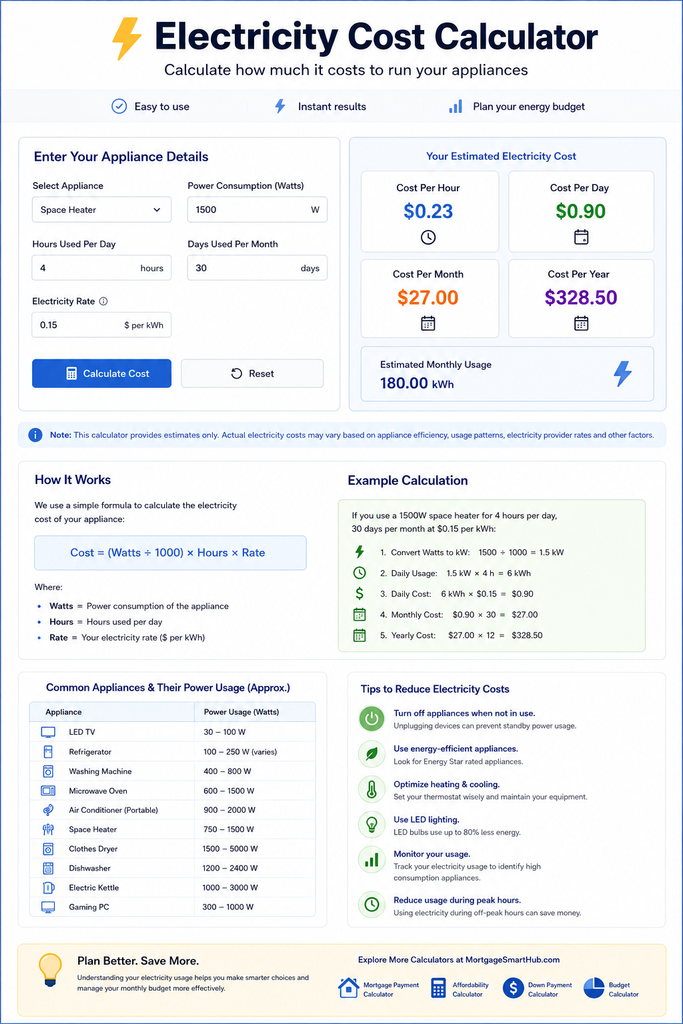
Electricity Cost = (Watts ÷ 1,000) × Hours Used × Electricity Rate
For example, imagine you use a 1,500-watt appliance for 4 hours per day.
First, convert watts to kilowatts:
1,500 ÷ 1,000 = 1.5 kW
Then multiply the power consumption by the number of hours used:
1.5 kW × 4 hours = 6 kWh per day
Finally, multiply the electricity usage by your electricity rate.
Your actual electricity bill may also include delivery charges, administration fees, taxes and other charges. For that reason, the calculator provides an estimate rather than an exact utility bill.
Understanding Watts, Kilowatts and kWh
What Are Watts?
Watts measure electrical power. Many appliances display their power rating on a label, in the instruction manual or on the manufacturer’s website.
For example, a small LED television may use significantly fewer watts than a portable space heater.
What Is a Kilowatt?
One kilowatt equals 1,000 watts.
For example:
500 watts = 0.5 kilowatts
1,000 watts = 1 kilowatt
1,500 watts = 1.5 kilowatts
What Is a Kilowatt-Hour?
A kilowatt-hour measures how much electricity is used over time.
For example, an appliance using 1,000 watts for one hour uses approximately 1 kWh of electricity.
An appliance using 1,000 watts for two hours uses approximately 2 kWh.
How Much Electricity Do Common Appliances Use?
Electricity usage varies significantly depending on the appliance model, age, efficiency rating and how it is used.
Here are approximate power ranges for common household appliances:
| Appliance | Approximate Power Usage |
|---|---|
| LED TV | 30–100 watts |
| Ceiling Fan | 15–100 watts |
| Refrigerator | Varies throughout the day |
| Chest Freezer | Varies throughout the day |
| Laptop | 30–100 watts |
| Desktop Computer | 150–500 watts |
| Gaming PC | 300–1,000 watts |
| Microwave | 600–1,500 watts |
| Coffee Maker | 600–1,500 watts |
| Electric Kettle | 1,000–3,000 watts |
| Air Fryer | 1,000–2,000 watts |
| Dishwasher | 1,200–2,400 watts |
| Clothes Dryer | 1,500–5,000 watts |
| Space Heater | 750–1,500 watts |
| Portable Air Conditioner | 900–2,000 watts |
| Vacuum Cleaner | 500–2,000 watts |
These figures are general estimates. Always check the manufacturer’s specifications or appliance label for more accurate information.
Example: How Much Does a 1,500-Watt Space Heater Cost?
Suppose a 1,500-watt space heater runs for 4 hours per day.
First, convert the wattage:
1,500 watts ÷ 1,000 = 1.5 kW
Daily electricity usage:
1.5 kW × 4 hours = 6 kWh
If your electricity rate is $0.15 per kWh:
6 kWh × $0.15 = $0.90 per day
If used every day for 30 days:
Approximately $27 per month
The actual cost may be different depending on your electricity rate and total utility charges.
Example: How Much Does a TV Cost to Run?
A television’s electricity consumption depends on its screen size, technology and usage.
For example, suppose a TV uses 80 watts and operates for 5 hours per day.
80 watts equals:
0.08 kW
Daily usage:
0.08 × 5 = 0.4 kWh
You can enter your own electricity rate into the calculator above to estimate the cost for your household.
Example: How Much Does a Gaming PC Cost to Run?
Gaming computers can consume different amounts of electricity depending on the hardware, graphics card and workload.
A computer used for basic browsing may consume much less electricity than the same computer running demanding games.
To estimate the running cost, enter the approximate wattage of your gaming PC, the number of hours used each day and your electricity rate.
For the most accurate estimate, consider using the actual power consumption measured during normal use rather than relying only on the maximum power rating.
How to Find Your Appliance’s Wattage
You may be able to find an appliance’s wattage in several places:
- On a label attached to the appliance.
- In the product manual.
- On the manufacturer’s website.
- On the original product packaging.
- By using an electricity usage monitor.
Some appliances do not consume their maximum rated power continuously. For example, refrigerators and air conditioners cycle on and off depending on temperature and operating conditions.
Because of this, using the rated wattage continuously may sometimes overestimate actual electricity consumption.
How to Reduce Your Electricity Costs
Small changes in household energy use may help reduce electricity consumption over time.
1. Turn Off Unnecessary Devices
Switching off devices that are not being used can help reduce unnecessary electricity consumption.
2. Use Energy-Efficient Appliances
Newer appliances may use less electricity than older models. When replacing an appliance, compare energy consumption and operating costs in addition to the purchase price.
3. Use LED Lighting
LED bulbs generally use less electricity than traditional incandescent lighting while providing a long operating life.
4. Adjust Heating and Cooling Usage
Heating and cooling equipment can significantly affect household energy consumption. Using appropriate temperature settings and maintaining equipment may help improve efficiency.
5. Monitor Your Electricity Usage
An electricity usage monitor or smart plug may help you understand how much energy individual devices consume.
6. Reduce Standby Power
Some electronics continue to use small amounts of electricity when they are turned off but remain connected to power.
Unplugging unnecessary devices or using a smart power strip may help reduce standby consumption.
Electricity Costs and Home Affordability
When planning to buy a home, it is important to consider more than just the mortgage payment.
Homeowners may also need to budget for:
- Property taxes
- Home insurance
- Electricity
- Heating
- Water and utilities
- Home maintenance
- Repairs
- Internet and other household services
Understanding your expected utility costs can help you create a more realistic monthly home budget.
You can also explore other financial tools on MortgageSmartHub to estimate mortgage payments, affordability and other homeownership expenses.
Frequently Asked Questions
How much does 1,000 watts cost per hour?
A 1,000-watt appliance uses approximately 1 kWh of electricity when operated continuously for one hour. The cost depends on the electricity rate you pay per kWh.
For example, at $0.15 per kWh, the electricity usage would cost approximately $0.15 per hour before considering other utility charges.
How do I calculate my electricity bill?
A simple estimate can be calculated by multiplying your electricity usage in kWh by your electricity rate.
However, an actual electricity bill may include additional charges, taxes, delivery costs or other fees.
How many kWh does a house use?
Electricity usage varies widely depending on the size of the home, number of occupants, climate, heating system, appliances and daily habits.
The best way to understand your household’s electricity usage is to review your utility bill and compare your monthly kWh consumption over time.
Does leaving appliances plugged in use electricity?
Some electronic devices consume electricity while in standby mode. The amount varies depending on the appliance.
Where can I find my electricity rate?
Your electricity rate may be listed on your utility bill or through your electricity provider. Enter the rate that applies to your household into the calculator for a more personalized estimate.
Is this electricity calculator accurate?
The calculator provides an estimate based on the information entered. Actual electricity consumption can vary depending on appliance efficiency, operating conditions, standby usage and your utility provider’s billing structure.
Related Mortgage and Home Calculators
Planning your household budget? Explore other calculators on MortgageSmartHub to better understand the costs associated with buying and owning a home.
- Mortgage Payment Calculator
- Mortgage Affordability Calculator
- Down Payment Calculator
- Mortgage Payoff Calculator
- Home Equity Calculator
- Monthly Budget Calculator
Understanding your mortgage payment together with utilities and other household expenses can help you make a more informed financial decision.