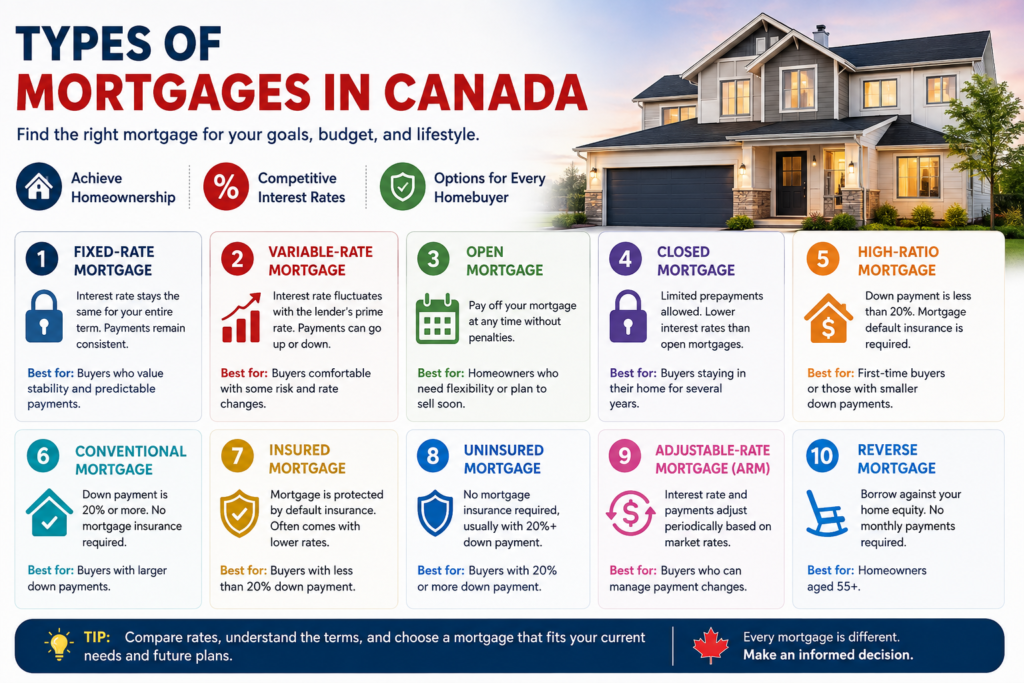
Which Mortgage is right for you
Buying a home is one of the biggest financial decisions you’ll ever make, and choosing the right mortgage is just as important as finding the right property. With so many mortgage options available in Canada, it’s easy to feel overwhelmed, especially if you’re buying your first home.
The good news is that you don’t need to be a financial expert to understand the basics. Once you know how each mortgage works, you’ll be in a much better position to choose the one that fits your lifestyle, budget, and future plans.
In this guide, we’ll explain the types of mortgages in Canada, their advantages and disadvantages, and who they’re best suited for. By the end, you’ll have a clearer picture of which mortgage may be right for you.
What Is a Mortgage?
A mortgage is a loan that helps you buy a home when you don’t have the full purchase price available upfront. In Canada, you’ll repay that loan over time through regular payments that include both the amount you borrowed (the principal) and the interest charged by your lender.
The type of mortgage you choose can affect your monthly payments, your borrowing costs, and even how much flexibility you have if your financial situation changes later.
1. Fixed-Rate Mortgage
A fixed-rate mortgage is the most popular mortgage choice among Canadian homeowners—and for good reason. With this option, your interest rate stays exactly the same throughout your mortgage term.
That means your monthly payment won’t change, even if market interest rates increase.
Best for:
- First-time homebuyers
- Families with fixed monthly budgets
- Buyers who value financial stability
Why many Canadians choose it
Imagine buying your first home and knowing exactly what your mortgage payment will be every month for the next five years. There are no surprises, making it much easier to budget for groceries, childcare, vacations, and everyday expenses.
Advantages
- Stable monthly payments
- Easy budgeting
- Protection from rising interest rates
Disadvantages
- Interest rates are often slightly higher than variable mortgages
- Breaking your mortgage early may result in larger penalties
2. Variable-Rate Mortgage
A variable-rate mortgage has an interest rate that changes as your lender’s prime rate changes.
When interest rates fall, you may pay less interest. If rates increase, your borrowing costs could rise.
Best for:
- Buyers comfortable with market changes
- Homeowners planning to keep their mortgage long-term
- People looking for potentially lower borrowing costs
Real-life example
Suppose you take out a variable-rate mortgage when rates are low. For the first couple of years, you could save thousands of dollars compared to a fixed-rate mortgage. However, if the Bank of Canada raises interest rates, your monthly costs may increase.
Advantages
- Lower starting interest rates
- Potential long-term savings
- Often lower penalties for breaking the mortgage
Disadvantages
- Less predictable payments
- Higher financial risk if rates rise
3. Closed Mortgage
A closed mortgage is the most common mortgage in Canada.
It offers lower interest rates but limits how much you can pay off early without paying penalties.
Best for
- Buyers planning to stay in their home for several years
- Homeowners who don’t expect to move soon
Advantages
- Lower mortgage rates
- More affordable borrowing
Disadvantages
- Penalties for paying off your mortgage early
4. Open Mortgage
An open mortgage gives you the freedom to pay off your mortgage whenever you want without significant penalties.
Although the interest rate is higher, this flexibility can be valuable if you expect to receive a large bonus, inheritance, or proceeds from selling another property.
Best for
- Homeowners planning to sell within a year
- Buyers expecting extra cash soon
Advantages
- Flexible repayment
- No major prepayment penalties
Disadvantages
- Higher interest rates
5. High-Ratio Mortgage
If your down payment is less than 20%, you’ll usually need a high-ratio mortgage.
Because the lender is taking on more risk, mortgage default insurance is required.
Best for
- First-time homebuyers
- Buyers with smaller savings
Advantages
- Purchase a home with as little as 5% down
- Easier access to homeownership
Disadvantages
- Mortgage insurance premiums increase the total cost of borrowing
6. Conventional Mortgage
A conventional mortgage requires a down payment of 20% or more.
Since the lender faces less risk, mortgage default insurance isn’t required.
Advantages
- No insurance premium
- Lower long-term borrowing costs
Disadvantages
- Larger upfront savings required
7. Insured Mortgage
An insured mortgage is backed by mortgage default insurance.
Many lenders actually offer slightly lower interest rates because the mortgage is insured.
Advantages
- Competitive interest rates
- Easier lender approval
Disadvantages
- Insurance premiums are added to your mortgage balance
8. Uninsured Mortgage
An uninsured mortgage generally applies when you’ve put down at least 20% or no longer require mortgage insurance.
Advantages
- No insurance premium
- More financing flexibility
Disadvantages
- Interest rates may occasionally be a little higher than insured mortgages
9. Adjustable-Rate Mortgage (ARM)
An adjustable-rate mortgage changes your monthly payment whenever interest rates change.
This differs from some variable-rate mortgages where the payment stays the same but the interest portion changes.
Best for
- Buyers who understand changing interest rates
- Homeowners comfortable with payment fluctuations
10. Reverse Mortgage
If you’re 55 or older, a reverse mortgage lets you borrow against your home’s equity without selling it.
Many retirees use this option to supplement their retirement income while continuing to live in their home.
Advantages
- No regular mortgage payments
- Access to tax-free cash
Disadvantages
- Interest accumulates over time
- Home equity gradually decreases
How Do You Choose the Right Mortgage?
There isn’t one “best” mortgage for everyone.
Ask yourself these questions:
- Do you want predictable monthly payments?
- Could you comfortably handle higher payments if interest rates rise?
- How long do you plan to stay in your home?
- Will you make extra mortgage payments?
- Are you buying your first home or upgrading?
Your answers will help narrow down the mortgage that’s best suited to your financial goals.
Final Thoughts
Choosing among the different types of mortgages in Canada isn’t just about finding the lowest interest rate. It’s about finding a mortgage that matches your lifestyle, your income, and your long-term plans.
A fixed-rate mortgage may provide peace of mind if you value predictable payments, while a variable-rate mortgage could save money if you’re comfortable with changing interest rates. Likewise, deciding between an insured or conventional mortgage depends largely on your down payment and financial situation.
Before signing any mortgage agreement, compare offers from multiple lenders, read the terms carefully, and use a mortgage calculator to estimate your monthly payments. A little research today can save you thousands of dollars over the life of your mortgage.
Whether you’re a first-time buyer, renewing your mortgage, or investing in another property, understanding your options is the first step toward making a confident home-buying decision.