Government programs can change, so always confirm current eligibility,
Buying a home in Canada can feel overwhelming, especially when you look at the down payment, closing costs, mortgage payments, property taxes, and other expenses that come with homeownership.
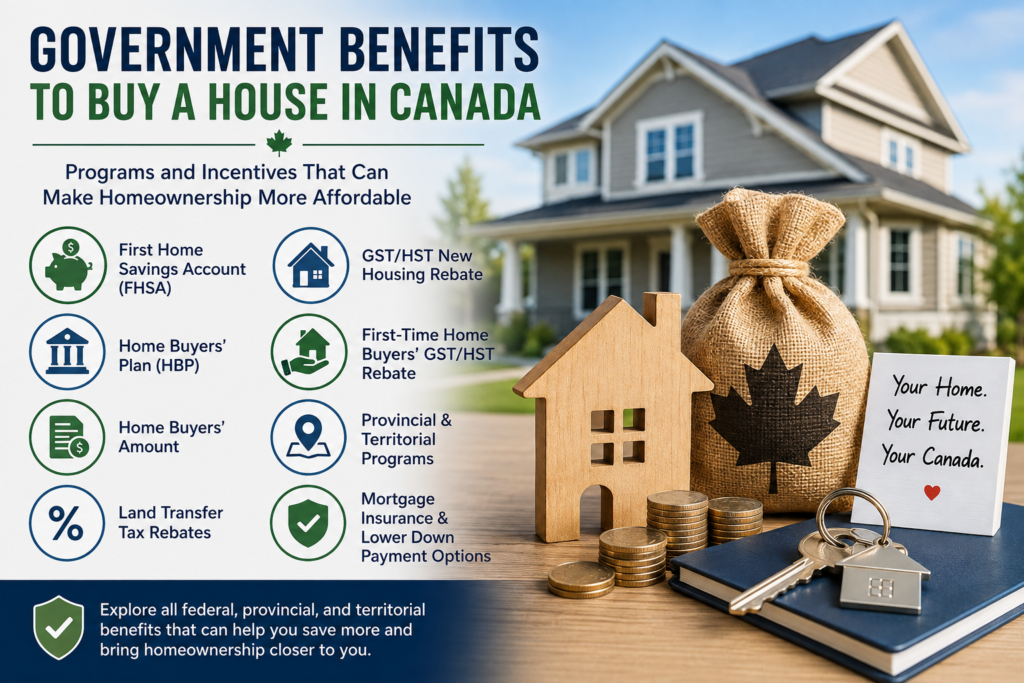
The good news is that Canadian homebuyers may be able to take advantage of several government programs, tax benefits, and incentives designed to make buying a home more affordable.
Some programs help you save for a down payment, while others can reduce your tax bill or make it easier to qualify for a mortgage.
This guide explains some of the most important government benefits for buying a home in Canada, including programs available to first-time homebuyers.
Important: Government programs and eligibility rules can change. Always verify the current requirements with the Government of Canada, CRA, your province, or a qualified mortgage professional before making a financial decision.
1. First Home Savings Account (FHSA)
The First Home Savings Account (FHSA) is one of the most useful programs for Canadians who are saving for their first home.
The account combines some features of an RRSP and a TFSA.
Eligible contributions can generally be deducted from your taxable income, while qualifying withdrawals used to purchase a first home can be made tax-free.
How the FHSA works
The FHSA has an annual contribution limit of $8,000, with a lifetime contribution limit of $40,000.
For example, if you contribute $8,000 to an FHSA, that contribution may qualify for a tax deduction, depending on your circumstances.
The money can then potentially grow inside the account, and qualifying withdrawals for your first home can be made without paying income tax on the withdrawal.
This can make the FHSA particularly valuable for people who are several years away from purchasing their first home.
Who can use an FHSA?
Generally, you must meet the federal requirements for opening an FHSA, including being within the required age range and qualifying as a first-time home buyer under the applicable rules.
The definition of a first-time home buyer can be different from simply saying, “I’ve never owned a house.”
For that reason, it’s important to check the current CRA requirements before assuming you’re eligible.
2. Home Buyers’ Plan (HBP)
Another federal program that can help eligible buyers is the Home Buyers’ Plan (HBP).
The HBP allows eligible individuals to withdraw money from their RRSP to help purchase or build a qualifying home.
Unlike a normal RRSP withdrawal, an eligible Home Buyers’ Plan withdrawal can generally be made without immediate income tax being charged on the withdrawal, provided the program’s requirements are met.
However, the money withdrawn generally has to be repaid to your RRSP over time.
This makes the HBP different from a grant or tax-free gift. You’re essentially accessing your own retirement savings earlier to help finance your home purchase.
FHSA vs. HBP
The FHSA and HBP aren’t necessarily competing programs.
Depending on your circumstances and eligibility, you may be able to use both when purchasing your first home.
This can potentially provide a larger pool of funds for your down payment.
Before making a withdrawal from an RRSP, however, consider how it could affect your retirement savings and speak with a qualified financial professional if you’re unsure.
3. Home Buyers’ Amount
First-time homebuyers may also be able to claim the Home Buyers’ Amount on their federal income tax return.
This is a non-refundable tax credit that can reduce the amount of federal income tax you owe.
The credit isn’t the same thing as receiving cash from the government.
Instead, it can reduce your tax payable when you file your tax return, assuming you meet the eligibility requirements.
The rules and maximum claim amount can change, so buyers should check the current CRA information for the applicable tax year.
4. GST/HST New Housing Rebate
If you’re buying or building a qualifying new home, you may be eligible for a GST/HST New Housing Rebate.
This program can help eligible buyers recover some of the GST or the federal portion of the HST paid on a qualifying new home.
Eligibility depends on factors such as:
- The type of property
- Purchase price
- Whether the property is new or substantially renovated
- Whether you intend to use it as your primary residence
- Other CRA requirements
This benefit can be particularly important when buying a newly constructed home because taxes can represent a significant portion of the total purchase cost.
5. First-Time Home Buyers’ GST/HST Rebate
The federal government has also introduced changes intended to provide additional GST relief for eligible first-time buyers of new homes.
The details, eligibility requirements, purchase-price limits, and implementation rules are important because they determine whether a particular buyer qualifies.
If you’re considering a newly built home, don’t simply assume that the rebate applies. Check the latest Government of Canada and CRA information before signing a purchase agreement.
6. Provincial and Territorial Homebuyer Programs
Federal programs aren’t the only benefits available.
Depending on where you live, your province or territory may offer additional homebuyer programs.
These can include:
- Land transfer tax rebates
- Property transfer tax exemptions
- First-time homebuyer credits
- Down payment assistance
- Affordable homeownership programs
- Municipal or regional incentives
For example, the rules for someone purchasing a home in Alberta can be very different from those applying to a buyer in Ontario or British Columbia.
This is why homebuyers should research both federal and provincial programs before finalizing their purchase.
7. Land Transfer Tax Rebates
Some provinces offer rebates or exemptions from land transfer taxes for qualifying first-time buyers.
Land transfer taxes are generally based on the property’s purchase price and can add thousands of dollars to the upfront cost of purchasing a home.
A first-time buyer who qualifies for a provincial rebate may therefore be able to reduce the amount of money required at closing.
The rules vary significantly by province.
Some locations may also have municipal land transfer taxes in addition to provincial taxes.
8. First-Time Homebuyer Incentives and Local Programs
From time to time, federal, provincial, territorial, and municipal governments introduce programs designed to make homeownership more accessible.
These programs can change as housing policies evolve.
Some may provide financial assistance, while others may focus on affordable housing, shared-equity arrangements, or specific groups of buyers.
Because programs can open, close, or change their eligibility rules, it’s worth checking official government websites shortly before purchasing a home.
9. Mortgage Insurance and the Minimum Down Payment
Government-backed mortgage insurance isn’t a cash benefit, but it can still play an important role for buyers with a smaller down payment.
In Canada, buyers who make a down payment below the applicable threshold may generally need mortgage default insurance.
Mortgage insurance can allow eligible borrowers to obtain a mortgage with a smaller down payment than would otherwise be required.
However, mortgage insurance comes with a premium, so buyers should consider the overall cost rather than viewing it as simply a benefit.
The minimum down payment requirements also depend on the property’s purchase price and current federal rules.
10. First-Time Buyers Don’t Always Need 20% Down
One common misconception is that every Canadian homebuyer needs a 20% down payment.
That’s not necessarily the case.
Eligible buyers may be able to purchase a home with a smaller down payment, although mortgage default insurance may be required.
For example, on a qualifying home priced at $500,000, a buyer may not necessarily need $100,000 saved before purchasing.
However, the exact minimum down payment rules depend on the purchase price and current federal regulations.
Buyers should also budget for closing costs in addition to the down payment.
11. Closing Costs You Should Budget For
Government benefits can help, but they don’t eliminate the other costs associated with purchasing a home.
Depending on the transaction, buyers may need to budget for:
- Legal fees
- Home inspection
- Appraisal
- Land registration fees
- Land transfer taxes where applicable
- Property tax adjustments
- Title insurance
- Mortgage insurance premiums where applicable
- Moving expenses
A buyer who has saved exactly enough for the down payment could still run into financial problems if there isn’t enough money available for closing costs and an emergency fund.
12. How Government Programs Can Work Together
One of the biggest advantages for eligible first-time buyers is that several programs may potentially work together.
For example, a buyer could potentially:
- Save money in an FHSA.
- Receive a tax deduction for eligible FHSA contributions.
- Use qualifying FHSA funds toward a home purchase.
- Use the Home Buyers’ Plan to access eligible RRSP savings.
- Claim the Home Buyers’ Amount if eligible.
- Take advantage of applicable provincial or territorial rebates.
- Qualify for a GST/HST rebate if purchasing an eligible new home.
The important point is that eligibility for one program doesn’t automatically mean eligibility for every other program.
Always check the rules for each benefit separately.
Example: How These Benefits Could Help
Imagine a first-time buyer has been saving for several years.
They have:
- $30,000 in an FHSA
- $25,000 available through eligible RRSP savings
- Additional savings for closing costs
The buyer purchases a qualifying home and meets the requirements for the applicable federal programs.
Instead of relying entirely on ordinary savings for the down payment, they may be able to combine eligible FHSA savings with funds accessed through the Home Buyers’ Plan.
If they also qualify for the Home Buyers’ Amount and a provincial or territorial benefit, the overall cost of purchasing the home could be reduced further.
The exact tax savings and available benefits will depend on the buyer’s personal circumstances and the rules in effect at the time of purchase.
Don’t Forget About Your Mortgage Qualification
Government assistance can make buying a home easier, but it doesn’t replace the need to qualify for a mortgage.
Lenders generally consider factors such as:
- Income
- Employment history
- Existing debt
- Credit history
- Down payment
- Property value
- Mortgage interest rate
- Monthly housing expenses
Buyers should therefore look at the entire picture rather than focusing only on the available government benefits.
A home may technically be affordable based on the down payment, but the monthly mortgage payment, property taxes, utilities, insurance, and maintenance costs still need to fit comfortably within the household budget.
A Smart Way to Plan Your Home Purchase
Before you start looking at houses, create a complete home-buying budget.
Start with your expected purchase price and then calculate:
Purchase price → Down payment → Mortgage amount → Monthly payment → Property taxes → Insurance → Utilities → Maintenance → Closing costs
Then investigate which government programs you may qualify for.
This approach can help you avoid a common mistake: finding a home you love before figuring out what you can realistically afford.
Frequently Asked Questions
What is the biggest government benefit for first-time homebuyers in Canada?
There isn’t one single benefit that is best for everyone. The FHSA can be particularly valuable because eligible contributions can provide tax deductions while qualifying withdrawals for a first home can be tax-free.
Can I use my FHSA and RRSP for a home purchase?
Eligible buyers may be able to use both an FHSA and the Home Buyers’ Plan. Each program has its own rules and limits.
Does the government give first-time buyers free money?
Some programs provide tax relief or rebates rather than a direct cash payment. Eligibility varies by program and location.
Do I need 20% down to buy a house in Canada?
Not necessarily. Eligible buyers can potentially purchase with a smaller down payment, although mortgage default insurance may apply.
Are there benefits for buying a new home?
Potentially. Eligible purchasers of qualifying new homes may be able to claim applicable GST/HST rebates, subject to the current rules.
Are there provincial benefits too?
Yes. Provinces and territories may have their own programs, including tax rebates and homeownership assistance.
Should I apply for every government program?
Not automatically. Each program has different eligibility requirements, and some programs may not apply to your situation. Review the rules carefully before relying on a benefit in your home-buying budget.
Buying a home in Canada requires more than saving a down payment. Understanding the government programs available to you can potentially save thousands of dollars or make it easier to put together the money needed for your purchase.
For first-time buyers, the FHSA, Home Buyers’ Plan, Home Buyers’ Amount, GST/HST rebates, and provincial programs are some of the areas worth investigating.
The key is to start early.
Don’t wait until you’ve found your dream home to research government benefits. Understanding your options before you start house hunting can help you determine how much you can realistically afford and how much money you’ll need at closing.
Government programs can change, so always confirm current eligibility, contribution limits, tax treatment, and deadlines with the Government of Canada, CRA, and your provincial or territorial government before making a decision.