9 Simple Strategies That Can Save You Money
Buying a home is a huge milestone, but once the excitement of getting the keys wears off, the reality of a mortgage payment can set in. For many Canadian homeowners, the mortgage is the largest monthly expense they have. That naturally leads to one question: How can I pay off my mortgage faster without putting too much pressure on my household budget?
The good news is that you don’t necessarily need to make a massive lump-sum payment to make progress. Small changes can add up over the years. Increasing your regular payment slightly, making an extra payment when you can, using accelerated biweekly payments, or taking advantage of your mortgage’s prepayment privileges can all help reduce your mortgage balance faster. The important thing is to choose a strategy that works with your finances rather than making your monthly budget uncomfortable.
Important: Mortgage contracts are different from one lender to another. Before making a large prepayment or changing your payment schedule, check your mortgage agreement and speak with your lender about your specific prepayment privileges and any potential penalties.
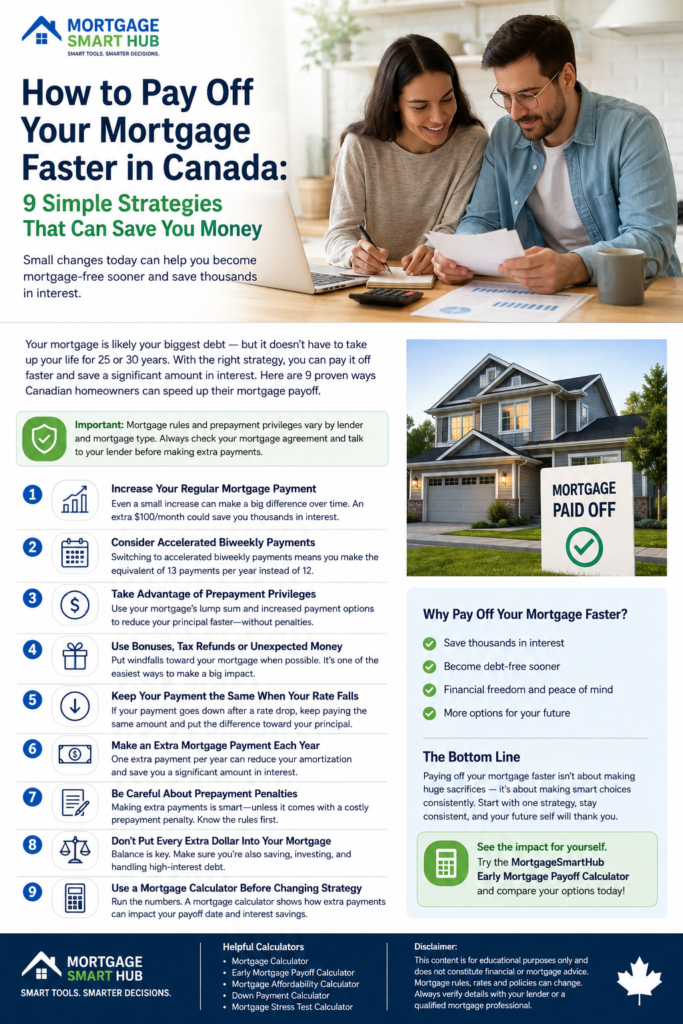
1. Increase Your Regular Mortgage Payment
One of the simplest ways to pay down your mortgage faster is to increase your regular payment. You don’t necessarily need to make a dramatic change. For example, if your current mortgage payment is $2,500 a month and your budget allows you to increase it to $2,600, that extra $100 goes toward reducing your mortgage balance faster.
It may not feel like a huge amount when you look at it month by month, but $100 a month becomes $1,200 over a year. If you continue doing this for several years, the additional principal payments can become significant. Reducing your principal sooner can also reduce the amount of interest you pay over the life of the mortgage.
The important thing is to choose an amount that you can comfortably maintain. Increasing your payment by $500 might sound great on paper, but if it makes it difficult to pay your other bills, it may not be the right strategy. Sometimes a smaller increase that you can maintain for years is the better choice.
2. Consider Accelerated Biweekly Payments
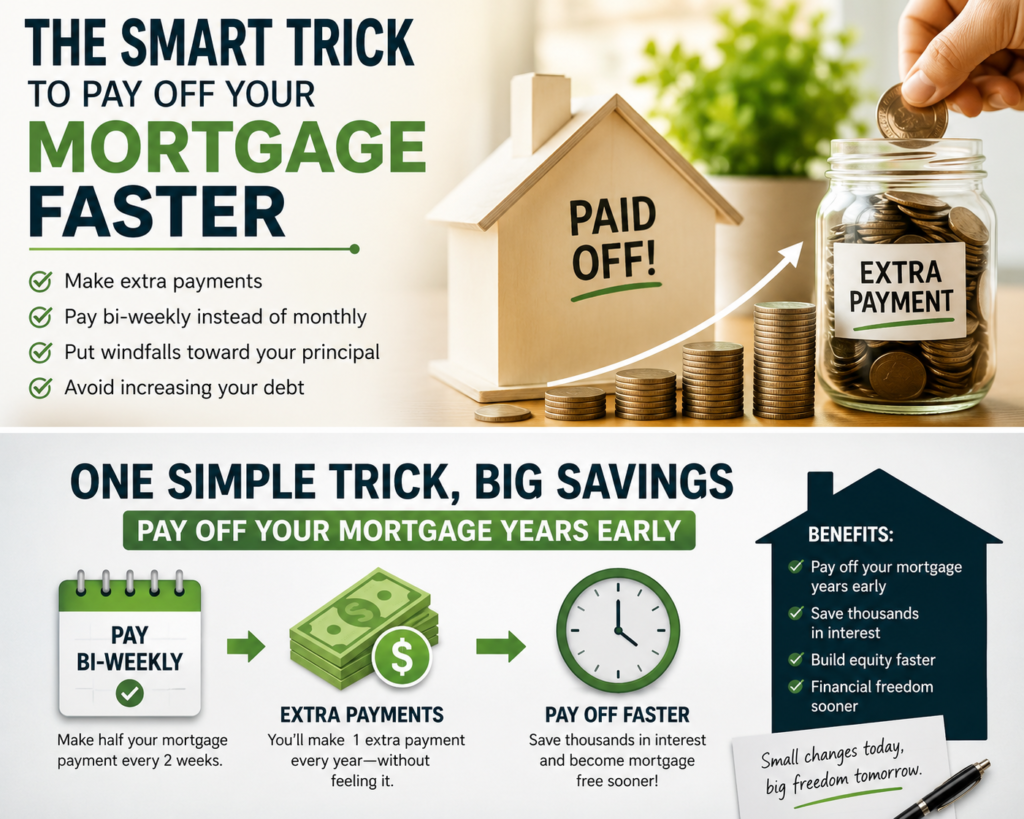
Another option Canadian homeowners often consider is switching from monthly payments to accelerated biweekly payments. Instead of making one mortgage payment each month, you make payments every two weeks. Because there are 26 biweekly periods in a year, an accelerated schedule can result in the equivalent of an additional monthly payment being made over the course of the year.
That additional money can help reduce your mortgage balance faster. For someone who gets paid every two weeks, the payment schedule can also fit naturally with their income.
However, don’t assume that every biweekly mortgage payment works the same way. There is a difference between regular biweekly and accelerated biweekly payments. Before making the switch, ask your lender how much you would actually pay over a full year and how the change would affect your mortgage.
3. Take Advantage of Your Mortgage’s Prepayment Privileges
If you want to pay your mortgage faster, one of the first things you should understand is your lender’s prepayment privileges. Many Canadian mortgages allow borrowers to make additional payments without paying a penalty, but the exact rules can vary significantly between lenders and mortgage products.
Your mortgage may allow you to increase your regular payments, make a lump-sum payment once or several times a year, or pay a certain percentage of your original mortgage balance. These privileges can be extremely useful because they allow you to reduce your mortgage principal without necessarily breaking your mortgage.
Don’t assume that your mortgage has the same rules as your neighbour’s mortgage. Even if you both use the same bank, your mortgage agreements may have different terms. Before making a large additional payment, take a few minutes to read your mortgage agreement or contact your lender and ask exactly what you’re allowed to do.
4. Use Bonuses, Tax Refunds or Unexpected Money
You don’t have to increase your monthly mortgage payment to pay your mortgage down faster. Another option is to use occasional money that you weren’t relying on for your regular household expenses.
For example, you might receive a work bonus, tax refund, inheritance, side-business income or another unexpected payment. Instead of automatically spending the money, you could consider putting some of it toward your mortgage if your mortgage contract allows it.
Imagine receiving a $5,000 bonus. You could spend the entire amount, save it, invest it, or use some or all of it to reduce your mortgage balance. There isn’t one answer that is right for everyone. Your emergency savings, other debts, investments and financial goals should all be considered before deciding what to do.
The main advantage of using unexpected income is that you can reduce your mortgage balance without permanently increasing your monthly expenses.
5. Keep Your Payment the Same When Your Rate Falls
Here’s a strategy that many homeowners don’t think about. Imagine you’re currently paying $2,700 a month, but after your mortgage rate changes, your required payment drops to $2,450.
It can be tempting to immediately enjoy the extra $250 in your monthly budget. And if your household needs that extra money, that’s completely understandable. But if you can afford to continue paying $2,700, you could direct that extra $250 toward your mortgage instead.
That works out to $3,000 over a year. You haven’t increased your payment compared with what you were already paying; you’ve simply decided not to reduce it when your required payment went down. Over time, that additional money can help bring your mortgage balance down faster.
6. Make an Extra Mortgage Payment Each Year
Another straightforward strategy is to make the equivalent of one additional mortgage payment each year. For example, if your regular mortgage payment is $2,500, you could aim to put another $2,500 toward your mortgage during the year, assuming your mortgage agreement allows the additional payment.
You don’t necessarily have to find $2,500 all at once. Some homeowners prefer to set aside a small amount each month so that the money is available when they are allowed to make their annual lump-sum payment. Others may use a tax refund or work bonus.
The important thing is to check your prepayment privileges first. Making an extra payment without understanding your mortgage terms could potentially result in a penalty.
7. Be Careful About Mortgage Prepayment Penalties
Paying off your mortgage faster sounds like a great idea, but there is one important detail you should never ignore: your mortgage contract.
Depending on your mortgage, you could face a prepayment penalty if you exceed your permitted prepayment amount or make certain changes before the end of your mortgage term. These penalties can sometimes be significant, so it is worth checking the details before making a large payment.
Before sending a substantial amount of money to your lender, ask how much you are allowed to prepay during the year, whether you can increase your regular payment, when lump-sum payments can be made, whether unused prepayment room carries forward and what would happen if you exceeded your limit.
Taking a few minutes to understand these rules could prevent an expensive surprise later.
8. Don’t Put Every Extra Dollar Into Your Mortgage
Being mortgage-free is a great goal, but it shouldn’t necessarily come at the expense of everything else.
Before aggressively paying down your mortgage, take a look at your complete financial situation. Do you have an emergency fund? Are you carrying high-interest credit-card debt? Do you have other loans? Are you saving for retirement? Do you have major expenses coming up?
For example, if you have expensive credit-card debt, putting an extra $500 toward your mortgage while leaving the credit-card balance untouched may not be the most efficient use of your money.
Instead of asking only, “How quickly can I pay off my mortgage?” it can be more useful to ask, “How can I improve my overall financial position?” Sometimes that means paying extra toward the mortgage. Sometimes it means building savings or paying down another type of debt first.
9. Use a Mortgage Calculator Before Changing Your Strategy
This is where doing a little homework can make a big difference. Rather than guessing whether an extra $100, $250 or $500 a month will make a meaningful difference, run the numbers and compare different scenarios.
For example, you could compare your current mortgage payment with a payment that is $100 higher, a payment that is $250 higher, an annual lump-sum payment or an accelerated biweekly schedule. Then look at how each option could affect your estimated payoff date, remaining balance and total interest.
This is exactly why mortgage calculators can be useful. They allow you to see the potential impact before committing to a new payment strategy.
Before changing your mortgage payment, run the numbers first with MortgageSmartHub’s mortgage and early-payoff calculators.
A Realistic Example: What Happens If You Pay $200 More?
Let’s make this simple. Imagine you’re comfortable increasing your mortgage payment by $200 a month. Instead of looking at that as another $200 expense every month, look at the bigger picture.
You’re putting an additional $2,400 toward your mortgage over a year. If you continue doing that, you’re consistently reducing your principal faster than you would have with your original payment.
The actual interest savings will depend on your mortgage balance, interest rate, remaining amortization, payment frequency and mortgage terms. That’s why you shouldn’t rely on a generic statement such as “you’ll save thousands.” Your mortgage is unique, and the best way to know the potential impact is to calculate it using your own numbers.
What About Canada’s Mortgage Stress Test?
The mortgage stress test is a separate issue from paying off your mortgage early, but it is important for Canadians who are buying or refinancing a home.
For uninsured mortgages, OSFI’s current minimum qualifying rate is the greater of the mortgage contract rate plus two percentage points or 5.25%. The purpose is to test whether borrowers can still afford their mortgage payments if interest rates or their financial circumstances become less favourable.
For homeowners, there is a broader lesson here: don’t create a mortgage budget that only works when everything goes perfectly. Homeownership comes with unexpected expenses, from repairs to property taxes and other household costs. Leaving some room in your budget can make homeownership much less stressful.
Should You Pay Off Your Mortgage or Invest?
This is one of those questions where you’ll probably hear completely different answers depending on who you ask.
One person might tell you to put every extra dollar toward your mortgage. Another might tell you that investing is always better. The reality is that neither approach is automatically right for everyone.
Paying down your mortgage reduces your outstanding debt and can reduce the amount of interest you pay over time. Investing, on the other hand, can potentially provide higher returns, but investment returns aren’t guaranteed.
Your mortgage rate, investment timeline, risk tolerance, emergency savings, other debts, retirement plans and overall financial goals should all be part of the decision.
For some homeowners, the answer may even be a combination of both: paying a little extra toward the mortgage while continuing to invest.
A Simple Way to Start Paying Your Mortgage Faster
If you’re reading this and thinking, “Okay, but where do I actually start?”, don’t make it complicated.
Start by looking at your current mortgage balance and reading your prepayment rules. Then decide how much extra you can comfortably afford without putting your household budget under pressure.
Maybe it’s $50 a month. Maybe it’s $100. Maybe you can make a $2,000 lump-sum payment once a year.
There is no magic number.
Once you’ve chosen an amount, use a mortgage calculator to compare it with your current payment. That will give you a much better idea of what the change could mean over the remaining life of your mortgage.
Then review your strategy once a year. Your income, expenses, mortgage rate and financial goals can all change, so your mortgage plan may need to change with them.
Frequently Asked Questions
Is it worth paying off a mortgage early in Canada?
It can be, depending on your financial situation. Paying down your mortgage can reduce your outstanding balance and future interest costs, but you should also consider emergency savings, other debts, investing and your overall financial goals.
Can I make extra mortgage payments whenever I want?
Not necessarily. Your mortgage agreement determines when and how much you can prepay without a penalty. Always check your lender’s rules before making a large additional payment.
Does paying extra toward my mortgage reduce interest?
Generally, reducing your principal earlier means future interest is calculated on a lower outstanding balance. The exact savings depend on your mortgage balance, rate, amortization and payment schedule.
Is accelerated biweekly better than monthly payments?
Accelerated biweekly payments can help you pay your mortgage faster because the payment schedule results in more money being paid toward the mortgage over a year. However, regular biweekly and accelerated biweekly payments are not necessarily the same, so check with your lender.
Can I pay off my mortgage before the end of my term?
You may be able to, but depending on your mortgage contract, you could face a prepayment penalty. Always ask your lender about the costs before breaking or paying off a mortgage early.
Should I use my tax refund to pay my mortgage?
It depends on your overall financial situation. If you have emergency savings and don’t have higher-priority debt, putting some of your tax refund toward your mortgage could be one option.
How much extra should I pay toward my mortgage?
There isn’t a universal amount. The right amount is one that you can afford consistently without putting your household finances under unnecessary pressure.
The Bottom Line
Paying off your mortgage faster doesn’t have to mean making a huge financial sacrifice. Sometimes it can be as simple as adding $100 to your regular payment, making one extra payment each year or continuing with your existing payment after your required payment decreases.
The most important thing is to understand your mortgage contract before making extra payments. Know your prepayment privileges, understand possible penalties and make sure your mortgage strategy fits into your larger financial plan.
Your goal shouldn’t simply be to become mortgage-free as quickly as possible. The bigger goal is to build a financial situation where your debt is manageable, you have enough money set aside for unexpected expenses and you feel comfortable with the direction you’re heading.
If you’re wondering how much difference an extra payment could actually make, don’t guess.
Put your numbers into the MortgageSmartHub Early Mortgage Payoff Calculator and compare the scenarios for yourself.