Learn how interest rate changes affect your mortgage payments, affordability, renewals, and borrowing power with simple Canadian examples and expert tips.
If you’re planning to buy a home or already have a mortgage, you’ve probably heard people talk about interest rates. But what do they actually mean for your wallet?
The truth is that even a small change in interest rates can make a noticeable difference to your monthly mortgage payment and the total amount you’ll pay over the life of your loan. That’s why keeping an eye on mortgage rates is important, whether you’re buying your first home, renewing your mortgage, or thinking about refinancing.
Why Interest Rates Matter
When you borrow money to buy a home, your lender charges interest on the amount you borrow. The higher the interest rate, the more expensive your mortgage becomes. On the other hand, lower interest rates reduce your borrowing costs and make homeownership more affordable.
While a difference of 1% may not seem like much, over a 25-year mortgage it can add up to tens of thousands of dollars.
A Simple Example
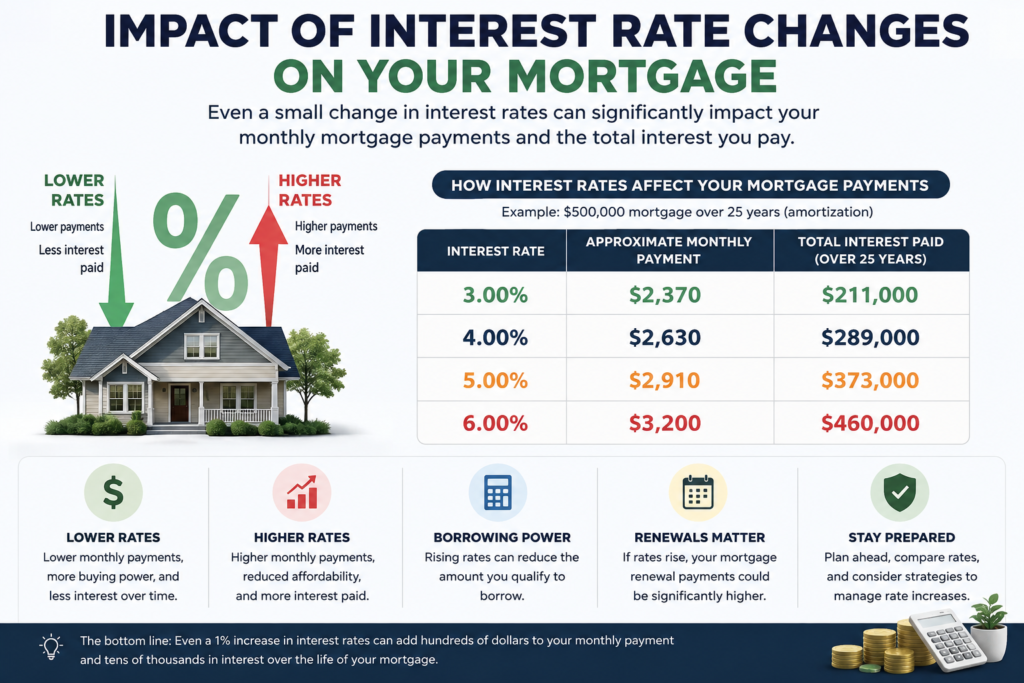
Imagine you’re taking out a $500,000 mortgage with a 25-year amortization.
At an interest rate of 3%, your monthly payment is roughly $2,370.
If rates increase to 4%, that payment jumps to around $2,630.
At 5%, you’re looking at approximately $2,910 every month.
And if rates climb to 6%, your monthly payment could reach about $3,200.
That’s an increase of more than $800 every month compared with a 3% mortgage. Over the years, the extra interest paid can easily reach hundreds of thousands of dollars.
Lower Interest Rates Mean More Buying Power
When mortgage rates are low, your monthly payments stay lower. This means you may qualify for a larger mortgage without increasing your monthly budget.
Many buyers use periods of lower interest rates to purchase a home, refinance an existing mortgage, or pay off their loan faster by keeping payments the same while more money goes toward the principal.
Lower rates can also make it easier for first-time buyers to enter the housing market.
Higher Rates Can Stretch Your Budget
When interest rates rise, borrowing becomes more expensive.
If you’re shopping for a home, you may qualify for a smaller mortgage than you would have a year earlier. In many cases, buyers have to adjust their expectations by choosing a less expensive property or increasing their down payment.
For homeowners with variable-rate mortgages, higher rates may also lead to higher monthly payments or slower progress toward paying off the principal.
Mortgage Renewals Can Be a Surprise
In Canada, many homeowners renew their mortgage every few years instead of keeping the same rate for the entire mortgage.
If your mortgage was originally signed during a period of low interest rates, renewing at today’s higher rates could mean a significant increase in your monthly payment.
This is why it’s a good idea to start planning several months before your renewal date. Shopping around and comparing offers from different lenders can sometimes save you thousands of dollars.
What Causes Interest Rates to Change?
Mortgage rates don’t move randomly. They’re influenced by several economic factors, including inflation, decisions made by the Bank of Canada, government bond yields, and overall economic conditions.
When inflation rises, interest rates often follow. When inflation cools, rates may begin to fall again. While no one can predict exactly where rates will go next, understanding these trends can help you make informed financial decisions.
How You Can Prepare
Although you can’t control interest rates, you can prepare for changes.
Making extra payments whenever possible can reduce your mortgage balance faster. Improving your credit score may help you qualify for better rates. Building an emergency fund can also provide peace of mind if your monthly payments increase in the future.
If you’re renewing your mortgage soon, comparing lenders instead of automatically accepting your current lender’s offer is always worth considering.
conclusion
Interest rates play a major role in the overall cost of owning a home. Even a small increase can have a significant impact on your monthly budget and the total interest you’ll pay over the life of your mortgage.
Whether rates are rising or falling, understanding how they affect your mortgage helps you make smarter financial decisions. The more informed you are, the better prepared you’ll be to choose the mortgage that fits your goals and your budget.