Learn how the mortgage stress test works in Canada, how it affects your borrowing power, and how to prepare for mortgage approval with our guide and calculator.
Buying a home in Canada is one of the biggest financial decisions most people make. Before a lender approves your mortgage application, they need to make sure you can handle your payments even if interest rates increase in the future. This is where the mortgage stress test in Canada comes into play.
The mortgage stress test is a qualification process used by federally regulated lenders to check whether borrowers can afford their mortgage payments at a higher interest rate than the one they are offered. The goal is to make sure homeowners are financially prepared for possible changes in interest rates.
What Is the Mortgage Stress Test?
The mortgage stress test is a calculation that determines whether you can afford your mortgage under a higher qualifying interest rate.
When you apply for a mortgage, your lender does not only look at your current mortgage payment. They also calculate whether you could still manage payments if rates rise.
For example, you may receive a mortgage rate of 4.5%, but your lender may evaluate your application using a higher qualifying rate. This higher rate creates a buffer between your current payment and a possible future payment increase.
The stress test applies to many mortgage applications, including:
- Buying a new home
- Refinancing an existing mortgage
- Switching lenders in some situations
- Applying for certain mortgage products
Why Does Canada Have a Mortgage Stress Test?
The purpose of the stress test is to reduce financial risk for homeowners and the Canadian housing market.
Interest rates can change over time. A homeowner who comfortably manages payments at one rate may experience financial pressure if rates increase significantly.
The stress test helps borrowers answer an important question:
“Could I still afford my mortgage if my payments become higher in the future?”
By testing affordability before approval, lenders can help ensure borrowers are not taking on more debt than they can reasonably manage.
How Does the Mortgage Stress Test Work?
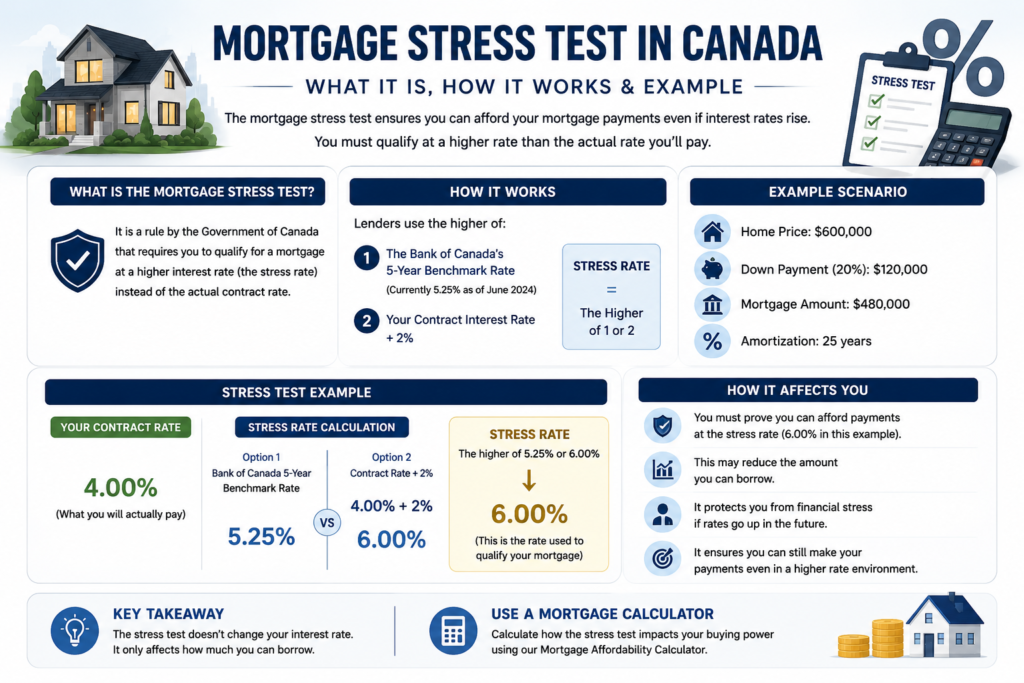
The lender calculates your mortgage affordability using a qualifying interest rate instead of your actual mortgage rate.
Your approval is generally based on the higher of:
- Your contracted mortgage interest rate plus an additional buffer
- A minimum qualifying rate set under Canadian mortgage rules
The calculation considers factors such as:
- Annual income
- Monthly debt payments
- Mortgage amount
- Interest rate
- Amortization period
- Property taxes
- Heating costs
- Other financial obligations
Example of a Mortgage Stress Test
Imagine you are applying for a mortgage of $500,000.
Your actual mortgage rate is 4.5%.
Your lender may test your ability to afford payments using a higher qualifying rate.
Although your actual monthly payment may be manageable, the stress test checks whether your finances could handle a larger payment amount.
This does not mean you will pay the higher amount. It is only used to determine whether you qualify.
How Does the Stress Test Affect How Much House You Can Buy?
The mortgage stress test can reduce your maximum purchasing power because lenders use the higher qualifying payment when calculating affordability.
For example, two buyers with the same income may qualify for different mortgage amounts depending on:
- Existing debts
- Down payment size
- Interest rates
- Credit history
- Monthly expenses
A lower debt level and larger down payment may improve your borrowing ability.
How Can You Improve Your Mortgage Qualification?
If you are preparing to buy a home, there are several ways to strengthen your mortgage application:
1. Reduce Existing Debt
Credit cards, car loans, and personal loans can affect your debt ratios. Paying down debt before applying may improve your affordability.
2. Save a Larger Down Payment
A larger down payment reduces the mortgage amount you need and can improve your overall financial position.
3. Improve Your Credit Score
A strong credit history can help you access better mortgage options and demonstrate responsible borrowing.
4. Consider Your Monthly Budget
Before buying, calculate your expected mortgage payment along with:
- Property taxes
- Insurance
- Utilities
- Maintenance costs
- Condo fees (if applicable)
Mortgage Stress Test vs Actual Mortgage Payment
One common misunderstanding is that the stress test rate is your actual mortgage rate.
It is not.
The stress test is only a qualification tool. Your real mortgage payment is based on your approved mortgage rate, term, and lender agreement.
The purpose is to confirm that you have enough financial flexibility.
Use Our Mortgage Stress Test Calculator
Before meeting with a lender, you can estimate your qualification using our Mortgage Stress Test Calculator Canada.
Our calculator helps you understand:
- Estimated qualifying payment
- Impact of higher interest rates
- Potential affordability changes
- Mortgage planning scenarios
Planning ahead can help you choose a home that fits comfortably within your budget.
Frequently Asked Questions
Is the mortgage stress test required in Canada?
The mortgage stress test applies to many mortgage applications with federally regulated lenders. Requirements can vary depending on your lender and mortgage situation.
Does the stress test affect my mortgage rate?
No. The stress test does not change your mortgage rate. It only affects whether you qualify for the mortgage amount you are requesting.
Can I fail the mortgage stress test?
Yes. If your income and debt levels do not support the qualifying payment, a lender may approve a smaller mortgage amount or decline the application.
Can a mortgage broker help with the stress test?
A mortgage professional can help you understand qualification requirements and compare mortgage options from different lenders.
Final Thoughts
The mortgage stress test is an important part of the Canadian home buying process. While it may reduce borrowing power for some buyers, it helps ensure homeowners choose mortgages they can manage over the long term.
Before purchasing a home, use mortgage planning tools to estimate your payments, affordability, and potential costs. Being prepared can make the home buying process easier and more predictable.